|
 |
 |
 |

|
Clarence William SMITH 1895-1969 - WW1 page 2/2
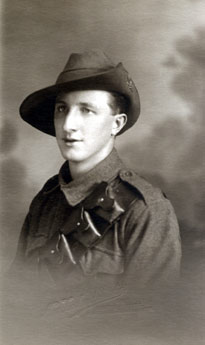
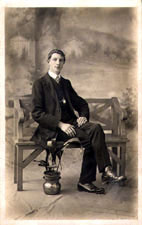
RETURN TO CIVILIAN LIFE After the war (Clarry) Clarence would never stand for the national anthem God Save the Queen and few understood his silent protest for the Australians sacrificed at Gallipoli. He believed that the British were responsible for landing the Australians in the wrong place. We can never fully understand what those soldiers went through and they way it wrecked their psyche. We heard about the lice they would pick out of their clothes and other discomforts they suffered but few returned soldiers could speak of the horrors they had experienced. The generation of grandchildren they produced can take a more compassionate view as we reflect upon the sometimes unsuccessful struggle of some 340 000 ex-service men and women to re-enter civilian life. Clarence was discharged from the AIF in Victoria on the 5th of May 1919 and returned to the 70th Infantry Unit, Victoria on 13 Jun 1919. He resumed his job at Graham's Boot Factory and continued to work for them for some time. Apparently he was 'never short of a quid' as he also had a good income from his contracts to supply three Ballarat bakers with 5 ft lengths of wattle to fire their ovens. This type of work began with his grandfather who was a carter in the early days of Ballarat. However Clarence did not come through the war unscathed. A 'yellow cross' shell from a German artillery barrage did irreparable damage. The mustard gas affected his eyes, throat, lungs and stomach. During the war his family recognised a change in his letters, in which the writing was so bad that it was almost unreadable and then the letters stopped. It was only after the war that the family discovered that he had been temporarily blinded and that his sight in one eye had been permanently lost.
It was a widely held view that General (later Lord) Allenby was the man who fulfilled the prophecy of the Bible by entering the Jaffa Gate to take Jerusalem. It was prophesied in the Bible that Armageddon would be where the final cataclysmic battle between the forces of good and evil would take place. Clarence was certainly not alone in his belief that the liberation of Palestine by the Commander of the Allied Forces in the Holy Land and the crucial armed conflicts of WW1 amounted to Armageddon. Apparently this was a fundamental tenet of an American-based religious movement known as the 'Judge Rutherfords' after their society's president. Clarence was caught up in their post war crusade and became a devout Jehovah's Witness. If we are charitable it is easy to see how such religious doctrine would appeal to an ex-soldier attempting to find solace and salvation for his wounded soul. Clarence became an obsessive Jehovah's Witness and would quote the Bible, chapter and verse, to anyone who would listen. He attended their conventions in Sydney and made donations to the Society at the expense of his family who received less and less as time went by. This created conflict with family members who would have none of it and continued to attended Neil Street Methodist Church. Domestic life was also exacerbated by episodes of drunkenness. As one old RSL member said, 'I never met a soldier who didn't enjoy a drink.' One of Clarry's digger mates revealed that 'he had quite an eye for the ladies in France' and it would seem that he continued to having a roving eye back home, as well as producing six more Smith children after the war.
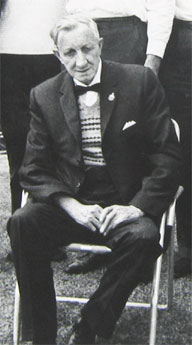
Only one of Clarence's eight children was able to make peace with their father so that late in life Clarence at least enjoyed the company of some of his grandchildren. They remembered him as a generous, kindly old gentleman and had little idea of what he must have suffered during the war or the extent of the ensuing domestic turmoil.
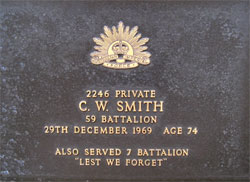 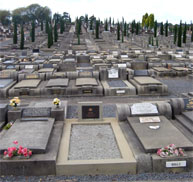 [Block Private C Section 5, Row 2, Grave 36] 29 March 2006 Clarence William Smith 1895-1969 - WW1 page 1 | ||||
 © Created : 28 September 2003 © Last Modified : 3 December 2023 Email : juniperballarat@gmail.com URL : http://juniperballarat.net/public_html/gen/smith/smith_cw2.html |