|
 |
 |
 |

Clarence William SMITH
|
ENLISTMENT
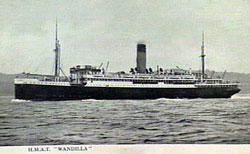
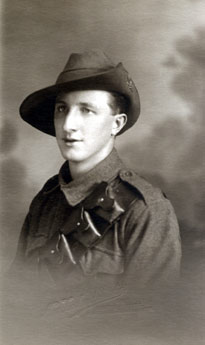
Clarence William Smith was born 12 Dec 1895 Ballarat s/o Henry George Smith and Eliza Lella Giles. He attended Black Hill State School and obtained his Merit Certificate on 7 Sep 1909. At the age of eighteen Clarence married Hilda Hutchins on 20 Jun 1914 at Neil Street Methodist Church. War was declared in August 1914 and the 7th Battalion was raised within a fortnight by Lieutenant Colonel H E 'Pompey' Elliott. Clarence was keen to enlist as he had served for three years in the 70th Regiment Senior Cadets. He was an apprenticed boot-clicker at the factory of Robert Graham & Sons when he first tried to join the volunteers for WW1 but his employer, Mr Graham, persuaded Clarence's mother to prevent him from enlisting and Eliza was able to do this as he was under age. Almost a year later on 10 Apr 1915, at the age of 19 and 4 months, with a wife and baby daughter Hillary and with his parents' consent, Clarence enlisted in the 1st Australian Imperial Force at the Curtis Street Barracks, Ballarat and embarked from Melbourne two months later on the 17 June 1915 with the 6th Reinforcements 7th Battalion on HMAT Wandilla. Five months after his departure Pte Smith's first son Clarence William was born so Hilda had two babies to raise alone for the duration of the war.
|
WAR SERVICE
2246 Private Clarence William Smith served on the Gallipoli Peninsula, Middle East and France with the following units:
7th Australian Infantry Battalion from 15 Jun 1915 to 24 Feb 1916
59th Australian Infantry Battalion from 24 Mar 1916 to 8 Jan 1917
The 59th Battalion was raised in Egypt on 21 February 1916 as part of the expansion of the AIF. Approximately half of its recruits came from the veteran 7th Battalion, and the other half were fresh reinforcements from Australia. Reflecting the composition of the 7th, the 59th was predominantly composed of men from rural Victoria. The battalion became part of the 15th Brigade of the 5th Australian Division.
On 19 July 1916, the 59th became embroiled in its first major battle on the Western Front, less than a month after it arrived in France. The battle of Fromelles was a disaster for the 59th. Attacking in the first wave, the 59th suffered heavy casualties at the hands of German machine-gunners, and its advance faltered far short of its objective. Despite grievous losses, the units of the 5th Division manned the front line around Fromelles for a further two months.
The 59th spent the winter of 1916-17 rotating in and out of the front line.
Australian War Memorial 59th Battalion
2246 Clarence William Smith was taken on strength from the 59th Battalion as a Sapper in the Anzac Light Railway Operating Company from 8 Jan 1917
On 14 Apr 1918 new designation for the 17th Australian Light Railway Operating Company was the 3rd Australian Light Railway Operating Company.
Light rail was used to convey ammunition to the gun batteries and also to transport soldiers and road or railway labourers to and from camp.
Australian War Memorial Light Railway Operating Company
1915
Pte Smith was with the 7th Battalion AIF when he went into battle for the first time at Gallipoli, replacing those who were killed on the original Anzac Day and holding out against the Turks for many months until the evacuation was complete on 20 Dec 1915. Some writing is illegible but mentioned in Pte Smith's Casualty Form - Active Service record in December 1915 are: Alexandria, to Mudros, Anzac Adv Base on 4th, Anzac; then - disembarked HMT Empress of Britain on 7 Jan 1916 at Alexandria, ex Lemnos.
1916
In the Middle East at Tel-el-Kebir on 24 Feb 1916, Pte Smith was taken on strength from the 7th Battalion to the 59th Battalion AIF. He was in the Egypt at Serapeum on 4 Mar 1916 and on 9 Jun 1916 at Moascar, north of Suez, Pte Smith was charged with 'Conduct prejudicial to military discipline in that he neglected to obey an order immediately.' The punishment was 7 hours pack drill and one week's fatigue.
He left Egypt on 18 Jun 1916 to join the British Expeditionary Forces on the Kinfauns Castle from Alexandria and disembarked at Marseilles the next day.
In the summer of 1916 the 59th Battalion was sent to the Western Front for the Allied Offensive against the German Line in France. The 59th Battalion, 15th Brigade, 5th Australian Division, was engaged in the Battle of Fromelles, close to the Belgian border, on the 19th and 20th of July 1916. It was the Australian soldiers' first major operation at the Western Front. In the Melbourne Age, 29 May 2008, journalist Ross MucMullin described the attack on the German trenches as the worst 24 hours in Australia's entire history as the advancing soldiers were machine gunned from higher ground, resulting in no fewer than 5533 Australian casualties in one night.
Pte Smith was first admitted to hospital on the 20th of November 1916, with influenza, rejoining his unit 9 days later on the 29th of November 1916. Apparently Clarence spent his 21st birthday (12 Dec 1916) on duty somewhere in France and the next day he was admitted to Anzac Casualty Receiving Station, France, with contusions to the back and chest and wounds to the fingers. He rejoined his Battalion eleven days later on the 24th of December 1916. We haven't yet determined the details of where he served with his unit on the Somme in France in Aug/Sep/Oct of 1916 or where he was wounded on this occasion.
Ballarat Courier, 9 Sep 1916
THE ENEMY WELL IN HAND
Signaller C. W. Smith, writing to his relatives in Ballarat, says:-
"We occupy billets now that were in the hands of the Germans a few months ago. The signallers work shifts of two hours on and 12 off, so we are not overworked, and we get plenty of sleep. The Tommies must have suffered when the Germans first used the gas, for they did not have the helmets that are in use now. I have been in one gas cloud. The helmets purify the air just as though there was no gas there. The Germans also use and fire shells which are known as weeping shells, because when they explode the fumes make your eyes run as if you were crying; but we have been issued with goggles to wear which prevents all that.
We are quite accustomed to aeroplane duels, and take no notice of them at all. We laughed at an incident which occurred this evening. There is a bonza big dog at this farm, and when the three blasts are given to get under cover from approaching aeroplanes the dog scampers for his kennel. It is marvellous how he knows what the whistle means. When one blast goes for 'All clear', he comes out again.
We have long days here; it is daylight at 3 o'clock and sunset at 10. I can feel this place shaking with the bombardment of our guns, which is in progress. The Red Cross ambulance does not go any further than the corner, and our chaplain has a big mug of hot coffee ready for all the wounded chaps before they get into the ambulance. You could hardly realize how fast the artillery can fire; one shell is bursting, one in the air, and another leaving the mouth of the gun.
The currency is peculiar here; a franc is worth 10d this month, but the currency differs - next month it may be worth 8d. They use notes for a franc and half a franc. A chap has a big roll of notes, yet he is only worth a few shillings.
During the night the firing line is not in darkness for any length of time on account of the incessant rain of star shells, which they fire about 60 feet in the air. They open out and form a big light until they reach the ground. They are very powerful, and come down slowly. I can understand what the population of Belgium went through in fleeing before the German advance. But, thank goodness, the Allies have the Germans well in hand; there are thousands of them being killed every day on the French frontier. George Douglas, from Ballarat, is here, and he is groom to the O.C."
(1533 Pte George Douglas, 23, Miner, Single, Presbyterian, enlisted 10 Dec 1914, 7th Infantry Battalion, 1 to 8 Reinforcements (Dec 1914-Aug 1915), embarked 19 Feb 1915 Melbourne on HMAT Runic, NOK Miss O Douglas, sister, 214 Drummond Street, North Ballarat, Victoria [Australian War Memorial])
1917
On 8 Jan 1917 Pte Smith was transferred from the 59th Battalion to the Anzac Light Railway Operating Company which later became the 17th ALROC and henceforth from the 9 Jan 1917, he was known as Sapper Smith. A Sapper was a Private in the Engineers. We imagine that as a Sapper/Signaller on the Western Front in a forward unit, Clarence was involved in the provision and maintenance of wireless and radio communication to the trenches. Perhaps he did a lot of digging, making forward communications trenches and laying light railways to transport ammunition to service the trenches in the front line. Apart from knowing that he was on the Somme we can't say what battles he may have been involved with.
On the 3rd of June 1917 Spr Smith was evacuated to a casualty clearing station for lengthy periods of 35 days and 28 days, returning to duty on the 4th of August 1917, but soon after he was again admitted to hospital.
Spr Smith was with the 17th ANZAC Railway Corps when he faced a court martial at the 1st Australian Division Base at Havre, France on 7 Nov 1917. The charge was, 'When on active service, breaking out of Camp, in that he, at No. 39 General Hospital Havre, on 20th October, 1917, broke out of hospital when his duty required him to be in hospital.'
A Lance Corporal testified that at about 7.30 pm when he had seen Spr Smith scale the railings of the hospital and head in the direction of Sanioe Church, he made the arrest and handed Spr Smith over to the guard at the hospital.
In his defence the accused stated that, 'On the night in question I was looking over the fence of No 39 General Hospital. I had some money and YMCA tickets in my hand. I dropped some of them over the fence and got over to recover them. As soon as I had got over I was arrested by the MP.' In response to cross examination, Spr Smith said, 'I had the money in my hand as I was counting it, it was change from the YMCA.' 'I was on the fence for the purpose of talking to a passer by.' 'I have served in the AIF for 2 years and 8 months and have never been tried by a Court Martial before nor have I ever been brought up before an officer for any offence.' It was noted that the accused 'declines to make any further statement.'
Spr Smith's plea was not guilty and the finding was guilty. The sentence was forfeiture of 90 days' pay, to which was added 19 days awaiting trial, so the total amounted to 109 days without pay.
1918
Clarence had been blinded on the Somme and remained in England convalescing prior to being repatriated with 'Defective Vision' to Australia. Spr Smith was one of 600 invalids on 'Transport D35' aboard HT Somerset which left Trinity Pier, Millbay Docks, Plymouth on 4 Dec 1918. He disembarked in Melbourne on 15 Jan 1919 and travelled home by train to Ballarat to meet his wife Hilda, daughter Hillary and his 3 year old son Clarence William Jnr for the first time.
On 14 Apr 1918 Spr Smith was discharged from 'L of C Hospital ex-sick' to duty at the Base Depot in France with the 3rd ALROC which was a new designation for the 17th ALROC. Three months later on the 28th of July 1918 Spr Smith was transferred from the Australian General Base Depot in France with defective vision and arrived the next day at No. 2 Convalescent Depot near Weymouth in England.
On 22 Aug 1918 Spr Smith was 'Found in Weymouth at 10.35 pm without a pass', for which he was confined to barracks for 7 days.
Clarence William Smith page 2 - Return to Civilian Life